Wesley Estate Residents Protest Against Data Centre
Concerns raised that the area is becoming a 'data heat island'
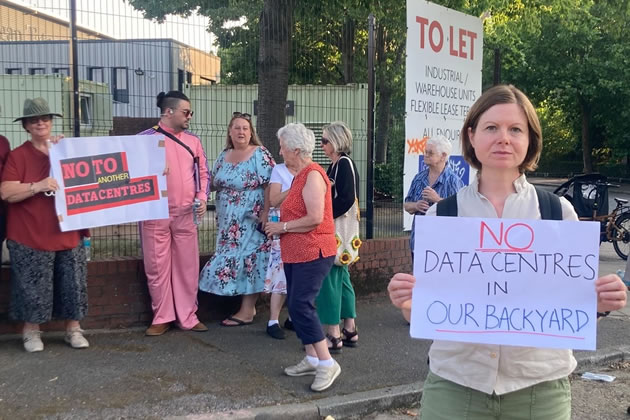
Residents ogathered outside the Frogmore Industrial Estate on Acton Lane to protest. Picture: FoE
July 22, 2026
Residents in Park Royal are calling for urgent, independent air-quality monitoring as demolition work begins on a new data centre site — the twelfth in the rapidly expanding Park Royal and North Acton cluster — amid growing concern that the area is becoming a “data heat island”.
Their demands come shortly after Ealing Council approved another major data centre development, this time on the former Honey Monster cereal factory site in Southall, intensifying fears that west London is being transformed into a high-impact industrial corridor without adequate environmental safeguards.
On Friday 17 July, residents of the Wesley Estate gathered outside the Frogmore Industrial Estate on Acton Lane to protest ahead of demolition works scheduled to begin on 21 July. Councillors from both boroughs attended, including Blerina Hashani (North Acton, Labour), Amandine Alexander (Harlesden and Kensal Green, Green) and Suzanne Gallagher (Kilburn, Green). Fourteen Green councillors across Ealing and Brent have also written formally to the Old Oak and Park Royal Development Corporation (OPDC) objecting to the demolition.
The Frogmore site is earmarked for a new facility by Kao Data. Park Royal already has around ten operational data centres, with another approved on Premier Park Road, making the Frogmore proposal the twelfth in the area. Residents say the cumulative impact is already intolerable. One resident living next to the existing Vantage Data Centre on North Acton Road described “years of continuous impact”, adding: “The dust from this data centre is unbelievable. We haven't had a break from drilling and grinding in years… My mental health is suffering from the noise and dirt.” Another parent said: “Being surrounded by data centres puts me and my children's future in jeopardy… It gives me little hope. I feel powerless.”
Campaigners argue that the neighbourhood is already in breach of World Health Organisation air-quality guidelines. According to Ealing Council’s own 2024 Annual Status Report, NO₂ levels across NW10 range from 19.4 to 30.9 µg/m³, against a WHO limit of 10 µg/m³. Background PM2.5 stands at 9.1 µg/m³, nearly double the WHO guideline of 5 µg/m³. With the Mayor of London committed to meeting WHO NO₂ limits by 2030, residents say further industrial development without real-time monitoring is incompatible with legal and environmental obligations.
The area’s only monitoring station on North Acton Road provides passive monthly averages, meaning pollution spikes during construction cannot be detected. ”
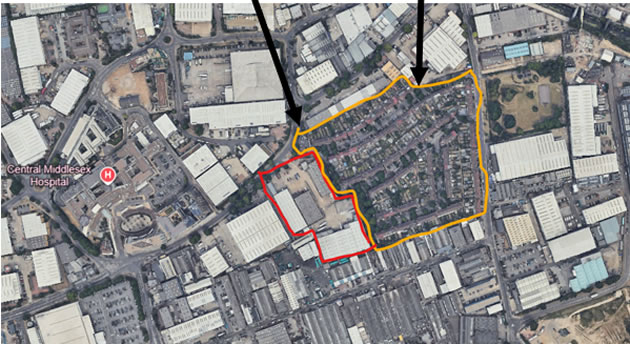
The data centre site marked with a red border and the Wesley Estate marked with a yellow border
Concerns extend beyond air quality to heat. Research shows that ground-level ozone forms faster in high temperatures and particulate matter spikes during heatwaves. A Cambridge University pre-print found temperatures rose between 1.5°C and 2.4°C after each data centre opened, with extreme cases reaching 9.1°C. In Slough, Europe’s largest data-centre hub, residents reported car-park temperatures of 45°C during the 2022 heatwave while nearby Windsor recorded 39°C. One Park Royal resident, aged 83, said her home reached 39°C during last month’s heatwave: “It’s been hell, and it’s still hell.”
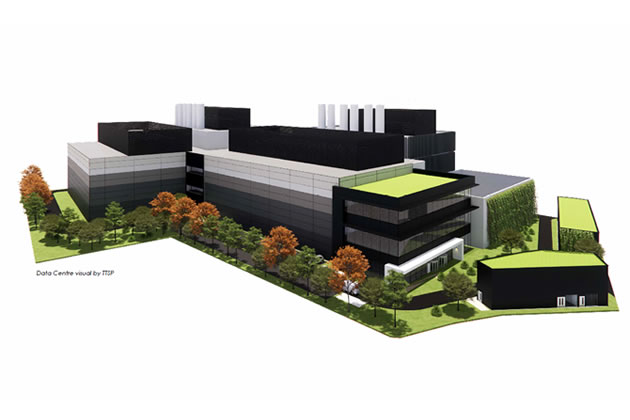
A visualisation of the Frogmore data centre from planning documentation
The Park Royal protest comes shortly after Ealing Council approved a major new data centre on the former Honey Monster factory site in Southall, a decision that has alarmed environmental groups who say the borough is now hosting multiple high-impact industrial developments without a coherent monitoring strategy. The Southall scheme, like the Park Royal cluster, is expected to generate significant heat and require substantial energy and cooling infrastructure. Campaigners argue that approving another large-scale data centre while failing to enforce OPDC’s Local Plan requirement for automatic air-quality monitors (Policy EU4) shows a widening gap between planning decisions and environmental responsibilities.
Ealing Friends of the Earth says both Ealing and Brent councils have legal duties under the Environment Act to review and assess air quality and take action. They are calling for continuous automatic monitoring across the Park Royal cluster, reactivation of real-time monitoring on North Acton Road, full public transparency of pollution data, and measurable year-on-year improvement targets.
Residents can send air-quality monitoring requests to both councils via a campaign link circulated by Ealing Friends of the Earth.
Like Reading Articles Like This? Help Us Produce More This site remains committed to providing local community news and public interest journalism. Articles such as the one above are integral to what we do. We aim to feature as much as possible on local societies, charities based in the area, fundraising efforts by residents, community-based initiatives and even helping people find missing pets. We’ve always done that and won’t be changing, in fact we’d like to do more. However, the readership that these stories generates is often below that needed to cover the cost of producing them. Our financial resources are limited and the local media environment is intensely competitive so there is a constraint on what we can do. We are therefore asking our readers to consider offering financial support to these efforts. Any money given will help support community and public interest news and the expansion of our coverage in this area. A suggested monthly payment is £8 but we would be grateful for any amount for instance if you think this site offers the equivalent value of a subscription to a daily printed newspaper you may wish to consider £20 per month. If neither of these amounts is suitable for you then contact info@neighbournet.com and we can set up an alternative. All payments are made through a secure web site. One-off donations are also appreciated. Choose The Amount You Wish To Contribute. If you do support us in this way we’d be interested to hear what kind of articles you would like to see more of on the site – send your suggestions to the editor. For businesses we offer the chance to be a corporate sponsor of community content on the site. For £30 plus VAT per month you will be the designated sponsor of at least one article a month with your logo appearing if supplied. If there is a specific community group or initiative you’d like to support we can make sure your sponsorship is featured on related content for a one off payment of £50 plus VAT. All payments are made through a secure web site. |