Park Royal Residents Face Being Surrounded by Data Centres
Latest plan would see massive facility near Wesley Estate
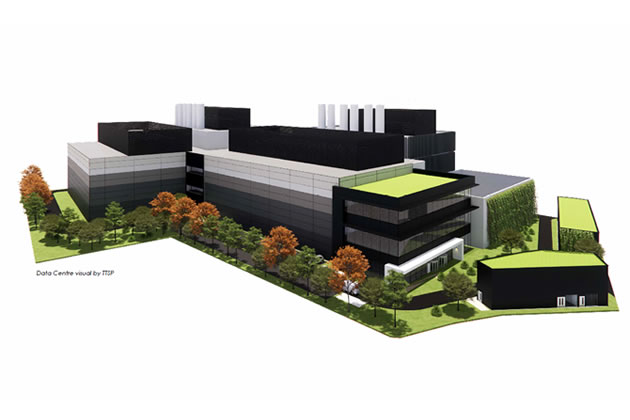
A visualisation of the Frogmore data centre from planning documentation
December 10, 2025
Residents of the Wesley Estate in Park Royal fear their homes will end up being surrounded by massive data centres if a planning application given the go ahead.
Permission is being sought from the Old Oak and Park Royal Development Corporation (OPDC) by ReAssure Limited, for a facility believed to take up 35,000 sqm of floorspace at the Frogmore Industrial Estate on Acton Lane. The proposal, submitted under planning application 25/0179/REMOPDC, would see buildings of up to 37 metres high built just metres from the historic 1930s housing estate.
Built nearly a century ago for stationery workers, the Wesley Estate is known for its distinctive terraced houses along Wesley Avenue, Harold Road, and Newark Crescent. Around 240 homes make up the estate, with a mix of social housing, owner-occupied, and privately rented properties. Despite being surrounded by industrial activity, the estate has retained its character and access to Wesley Playing Fields, a valued local green space.
Residents say the Frogmore scheme would be the eleventh data centre in the Park Royal/North Acton area. With the Vantage Data Centre on North Acton Road recently completed, and a Microsoft facility on Volt Road/Bashley Road due to open in January 2026, locals fear being hemmed in by large-scale developments. If approved, the Frogmore site would place three centres within half a kilometre of the estate.
The site already has outline planning consent which establishes the principle of redevelopment for data centre use. This latest application is reserved matters submission which seeks approval for the detailed aspects of the scheme, specifically appearance and layout. A statement with the applications says it, “demonstrates how the scheme has been designed to deliver a high-quality, functional, and sustainable data centre facility that sits appropriately within its setting.”
The proposed building run along the full length of the estate. The closest homes would be just 19 metres away. Residents worry about the loss of daylight, privacy, and outlook, as well as the strain on local infrastructure. Acton Lane, already a busy distributor road with six bus routes, also serves nearby health facilities including Central Middlesex Hospital and the Victoria Care Centre. Locals recall road closures during the construction of the Vantage centre, which they say disrupted patient access to appointments.
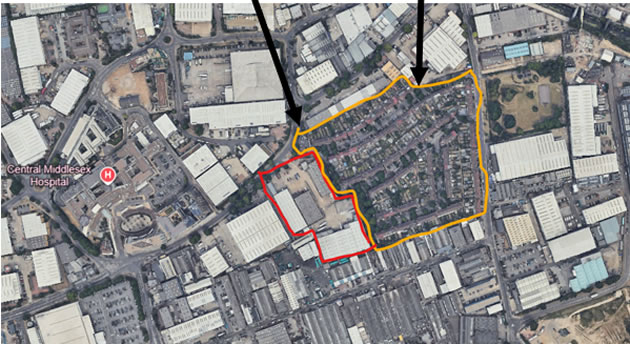
The data centre site marked with a red border and the Wesley Estate marked with a yellow border
Objections submitted to the Old Oak and Park Royal Development Corporation (OPDC) highlight concerns about the use of diesel backup generators, which emit nitrogen dioxide and particulate matter. Campaigners argue this could worsen air quality in an area already identified as poor by the London Atmospheric Emissions Inventory. Thames Water has also raised issues, stating that the existing water network cannot accommodate the additional demand, and requesting conditions to ensure upgrades before occupation.
Residents point to their experience during the Vantage Data Centre build, describing months of noise, dust, and vibration. Some recall construction continuing through the night, with windows rattling as foundation piles were hammered into the ground. “It was a living nightmare,” one resident wrote in an objection email, noting that even now roadworks continue to lay new electricity cables for the facility.

A photo of an interior of a data centre submitted with the application
Since learning of the application through street notices and door-to-door flyers, residents have organised to submit objections via the OPDC planning portal. Volunteers have assisted elderly neighbours in drafting and uploading comments. Campaigners argue that meaningful consultation has been lacking, and that cumulative impacts of multiple data centres have not been properly assessed.
Documents submitted with the application point to the UK’s growing need for digital infrastructure, with data centres seen as critical to the economy and public services. The Frogmore proposal includes landscaping, green walls, and sustainability measures, aiming to soften its industrial impact. However, residents insist that without a full cumulative impact assessment and binding conditions on emissions, noise, and traffic, the development risks overwhelming a historic residential community.
Like Reading Articles Like This? Help Us Produce More This site remains committed to providing local community news and public interest journalism. Articles such as the one above are integral to what we do. We aim to feature as much as possible on local societies, charities based in the area, fundraising efforts by residents, community-based initiatives and even helping people find missing pets. We’ve always done that and won’t be changing, in fact we’d like to do more. However, the readership that these stories generates is often below that needed to cover the cost of producing them. Our financial resources are limited and the local media environment is intensely competitive so there is a constraint on what we can do. We are therefore asking our readers to consider offering financial support to these efforts. Any money given will help support community and public interest news and the expansion of our coverage in this area. A suggested monthly payment is £8 but we would be grateful for any amount for instance if you think this site offers the equivalent value of a subscription to a daily printed newspaper you may wish to consider £20 per month. If neither of these amounts is suitable for you then contact info@neighbournet.com and we can set up an alternative. All payments are made through a secure web site. One-off donations are also appreciated. Choose The Amount You Wish To Contribute. If you do support us in this way we’d be interested to hear what kind of articles you would like to see more of on the site – send your suggestions to the editor. For businesses we offer the chance to be a corporate sponsor of community content on the site. For £30 plus VAT per month you will be the designated sponsor of at least one article a month with your logo appearing if supplied. If there is a specific community group or initiative you’d like to support we can make sure your sponsorship is featured on related content for a one off payment of £50 plus VAT. All payments are made through a secure web site. |