Police Officer Says Patience Needed for Operation Broad Oak
Reports from residents have been crucial in progress made so far
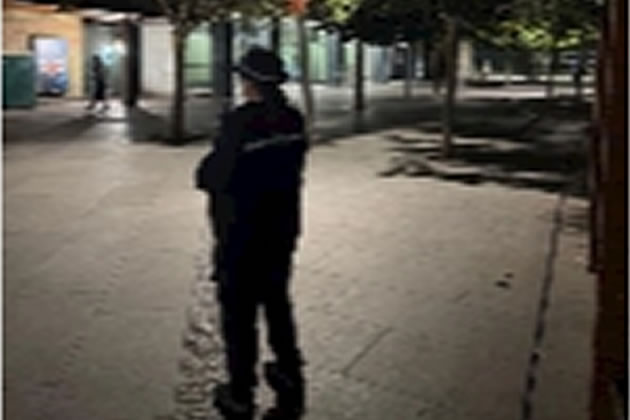
An officer on patrol on The Mount at night. Picture: Met Police
Operation Broad Oak continues to move forward across Acton this September, with police officers, council teams and community partners working together to tackle antisocial behaviour and drug-related activity in some of the area’s most affected locations. In his latest update to residents, PC George Zealey emphasised that while progress is being made, the operation was always designed as a long-term effort rather than a quick fix, and that sustained improvement will depend on continued partnership work and community engagement.
PC Zealey began by thanking residents for the reports they continue to submit. These accounts of antisocial behaviour, suspicious activity and recurring problems remain central to the operation, helping officers understand where issues are emerging, how patterns are shifting and where patrols should be directed. He noted that conversations with residents, businesses and community groups have been equally valuable, whether through formal meetings or informal chats while officers are out on patrol. That direct contact, he said, is at the heart of neighbourhood policing and continues to shape the operation’s priorities.
He acknowledged that many residents understandably want to see rapid improvements, but explained that Operation Broad Oak is built on the Clear, Hold, Build model, a structured approach used nationally to stabilise areas affected by persistent crime and disorder. The current Clear phase focuses on identifying individuals causing the greatest harm and using a range of enforcement tools to disrupt their behaviour. Officers have been issuing Community Protection Warnings and Notices, securing Criminal Behaviour Orders where appropriate and progressing persistent offenders through these measures when their behaviour continues. At the same time, referrals are being made to support services to address underlying issues such as addiction, recognising that enforcement alone cannot resolve long-standing problems linked to Class A drug dependency.
Alongside policing, extensive partnership planning is underway to explore how physical changes to problem locations could reduce opportunities for crime and help residents reclaim their public spaces. This includes discussions about lighting, access, layout and long-term environmental improvements. PC Zealey stressed that these strands of work need to operate together if the operation is to achieve meaningful and lasting change.
Since Operation Broad Oak began, officers have issued dozens of Community Protection Warnings and Notices, made arrests for drug and weapons offences, conducted targeted stop and searches and secured both court orders and convictions linked to breaches of previous enforcement measures. He highlighted a recent arrest near Woodlands Park, where officers acting on shared intelligence stopped a man and found forty-seven wraps of suspected drugs. The man was charged with possession with intent to supply Class A drugs and remanded to court. During September alone, officers are expected to dedicate thirty-one shifts specifically to Broad Oak activity, including overtime on rest days and adjusted shifts to provide later-evening coverage. All of this is being delivered alongside wider neighbourhood policing responsibilities across Acton and Ealing.
As autumn approaches, officers will monitor whether earlier evenings and changing weather affect when and where antisocial behaviour occurs. Patrols will be adjusted in response to intelligence and resident reports, and PC Zealey stressed again that timely, specific information remains vital. Details about locations, times, descriptions and recurring patterns help officers build a clearer picture and target resources more effectively.
Work with Ealing Council, community organisations and local businesses continues in parallel with enforcement. At The Mount, discussions are progressing around potential environmental improvements, though issues of land ownership, responsibility and funding mean changes cannot happen overnight. Similar planning is underway at Woodlands Park, where a joint action day is being organised with Ealing Council and Greener Ealing. The event will bring partners together for a coordinated clean-up, support improvement works around the pond and provide a highly visible multi-agency presence. Longer-term discussions include potential changes to access and gating, CCTV and community-led initiatives designed to make the park safer and more welcoming.
PC Zealey noted that reported antisocial behaviour across Acton has continued to show a downward trend since June. While encouraging, he cautioned that statistics only tell part of the story. Drug-related activity and antisocial behaviour continue to affect some locations, and a reduction in overall reports does not mean the problem has been resolved. Operation Broad Oak is ultimately about achieving sustained, long-term improvement, not simply shifting problems from one area to another or delivering temporary reductions in offending.
He closed by thanking residents once again for their engagement and information, and reaffirmed the commitment of officers, council teams and partners to working together to make Acton’s shared public spaces safer, more welcoming and more resilient in the months ahead.
Click here to sign up for Met Engage if you haven’t already done so.
Value Reading Articles Like This? Help Us Produce More This site remains committed to providing local community news and public interest journalism. Articles such as the one above are integral to what we do. We aim to feature as much as possible on local societies, charities based in the area, fundraising efforts by residents, community-based initiatives and even helping people find missing pets. We've always done that and won't be changing, in fact we'd like to do more. However, the readership that these stories generates is often below that needed to cover the cost of producing them. Our financial resources are limited and the local media environment is intensely competitive so there is a constraint on what we can do. We are therefore asking our readers to consider offering financial support to these efforts. Any money given will help support community and public interest news and the expansion of our coverage in this area. A suggested monthly payment is £8 but we would be grateful for any amount for instance if you think this site offers the equivalent value of a subscription to a daily printed newspaper you may wish to consider £20 per month. If neither of these amounts is suitable for you then contact info@neighbournet.com and we can set up an alternative. All payments are made through a secure web site. One-off donations are also appreciated. Choose The Amount You Wish To Contribute. If you do support us in this way we'd be interested to hear what kind of articles you would like to see more of on the site – send your suggestions to the editor. For businesses we offer the chance to be a corporate sponsor of community content on the site. For £30 plus VAT per month you will be the designated sponsor of at least one article a month with your logo appearing if supplied. If there is a specific community group or initiative you'd like to support we can make sure your sponsorship is featured on related content for a one off payment of £50 plus VAT. All payments are made through a secure web site. |